The Biggest Misconception Customers Have about Privacy Screens
When your privacy is invaded by a neighbour or an unsightly addition which you want to avoid you need to understand which factors will be providing you with privacy.
Critical questions to ask when you are spending money on home renovations and upgrades.
How Long Do Laser Cut Privacy Screens Last?
If you've ever admired a laser cut steel screen online and wondered whether it would give you the privacy you need — you're not alone.
It's one of the most common questions we get at Deco Zoosh, and the honest answer is: it depends on a few things that most people don't think to ask about upfront.
After years of supplying and installing laser cut screens across a wide range of projects, here's what we've learned about how privacy works with these products.
The Biggest Misconception Customers Have
Before we even get to privacy, there's something more fundamental that surprises almost every new customer: a laser cut panel is not a plug-and-play solution.
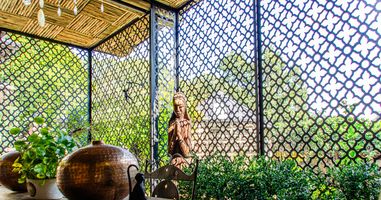
People see a beautiful screen online and assume they can simply prop it up as a gate or stand it in their garden as a freestanding feature. What they don't realise is that to function as a gate — sliding or hinged — or as a freestanding installation, there's construction involved. You need the right infrastructure: posts, tracks, footings, or frames depending on the application.
This matters for privacy because an incorrectly installed screen — one that's too short, not properly anchored, or positioned at the wrong angle — won't give you the coverage you're looking for, regardless of how good the design is.
The Two Factors That Actually Determine Privacy
Once the installation is set up correctly, privacy comes down to two things: design and colour.
Design Is Everything
Not all laser cut patterns are created equal when it comes to privacy. The key variable is the aperture — the size of the openings in the pattern.
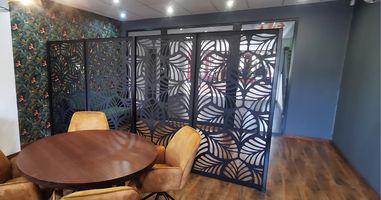
Floral designs, for example, tend to work exceptionally well for privacy because the organic shapes create overlapping visual layers that break up sightlines effectively. Geometric patterns with larger open sections are more decorative than private.
At Deco Zoosh, when a client has a specific privacy requirement, we look directly at the gap ratios in the design and make sure the apertures aren't large enough to create a clear line of sight.
This is something we've refined through experience. We've had one or two cases where clients felt the openings were slightly too large for their comfort, and those experiences have shaped how we approach the design conversation upfront. Today, addressing aperture size is a standard part of our process — not an afterthought.
Colour Makes a Bigger Difference Than You'd Expect
Here's something most people don't consider: a darker coloured screen is significantly more effective at blocking the eye than a lighter one, even with the same pattern.
Dark colours — matte black in particular — absorb light and make it far harder for the eye to trace the openings in the design. A lighter coloured screen in the same pattern will appear more open visually, even though the physical gaps are identical.
If maximum privacy is the goal, colour choice is part of the privacy solution, not just an aesthetic decision.
What Happens On Site
Beyond the screen itself, installation context plays a role. A screen on a boundary wall behaves differently from one on a balcony. If neighbours overlook from an elevated position, the height and angle of the screen need to account for that specific sightline — not just the standard eye-level view from the street.
These are details we work through on site. Privacy is rarely a one-size-fits-all calculation, and what works for a garden boundary might need adjustment for a second-floor balcony or a pool area with specific angles of exposure.
What Our Clients Actually Experience
The overwhelming response once a laser cut screen goes up is surprised — and not the bad kind. Most clients are genuinely taken aback by how much the screen transforms the space. The visual impact of a well-chosen pattern tends to exceed expectations, and the privacy function almost always meets them.
The rare cases where clients felt the screen wasn't quite private enough came down to aperture size in the chosen design — something we now address proactively during the design phase, before anything goes into production.
How Laser Cut Screens Compare to the Alternatives
It's worth putting laser cut screens in context against the other options people typically consider.
Solid walls offer total privacy, but they're permanent, heavy, and do nothing for the aesthetics of a space. Once it's up, it's up.
Wooden slats give a natural look but deteriorate over time. Rot, warping, and maintenance are real concerns in South African conditions.
Glass balustrades are low-maintenance and modern, but they offer zero privacy — and no pattern.
What a laser cut steel screen gives you that none of these alternatives can is the combination of privacy and design. The pattern itself has intrinsic value. It changes the entire feel of a space, adds visual interest from both sides, and — critically — it's something you won't grow tired of looking at.
At Deco Zoosh, our motto is "lifetime designs," and that's not just marketing language. These screens are built from steel that lasts, with designs chosen to have enduring appeal rather than trend-driven novelty.
The Bottom Line
A properly designed and correctly installed laser cut privacy screen provides genuine, functional privacy — not a compromise. The keys are choosing the right pattern (pay attention to aperture size), selecting a darker colour if privacy is the priority, and making sure the installation accounts for the specific sightlines on your property.
If you're unsure whether a particular design will give you the coverage you need, that's a conversation worth having before you order. We'd rather get it right at the design stage than have a client wishing the gaps were a little smaller once the screen is up.