Balcony Privacy Screens: What to Consider Before You Buy
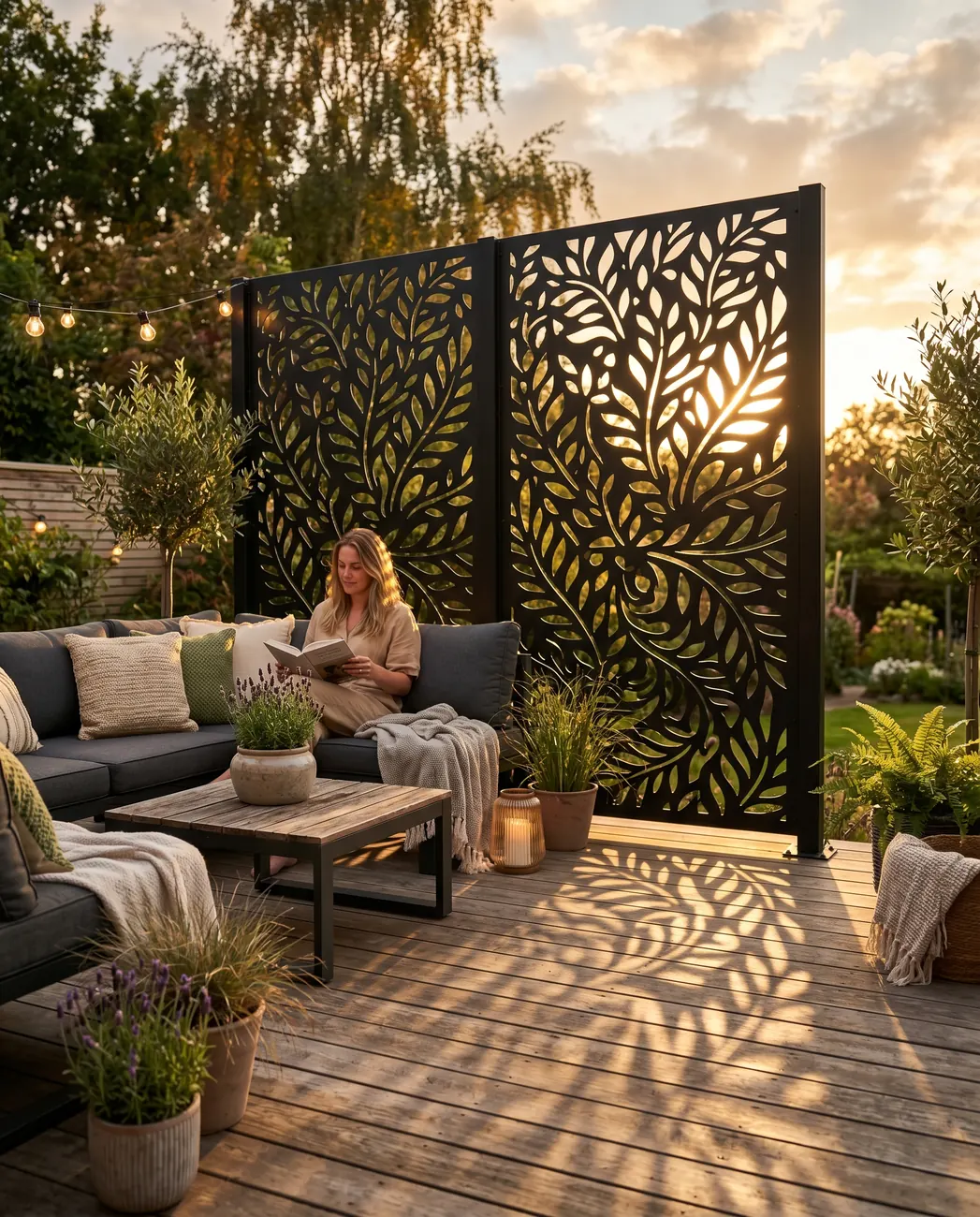
A balcony should feel like an extension of your home — not a fishbowl.
Whether you’re looking out over a neighbour’s rooftop, sitting level with the unit next door, or simply wanting to enjoy your outdoor space without an audience, a laser cut privacy screen is one of the most effective and most attractive solutions available. But balconies come with their own set of considerations that a standard wall installation doesn’t.
Here’s what to think through before you buy.
The Most Common Balcony Setup We Work With
Most balcony screen projects we see follow the same basic pattern.
A straight screening section runs along the open face of the balcony, with a separate railing section stepping down the stairs alongside it. These two elements — the screen and the balustrade — need to work together visually and structurally. We join laser cut sections using posts, which gives us solid fixing points, excellent stability, and the kind of structural strength you need when something is also functioning as a balustrade. That last point matters more than most people realise.
A balustrade that looks good but moves when you lean on it is a safety problem, not just an aesthetic one.
Fixing, Posts, and Why Structural Integrity Isn’t Optional
Balustrading has to be engineered to take load — full stop.
This is one of the areas where standard off-the-shelf panels consistently fall short. They’re designed to be screens, not balustrades, and the fixing method is usually an afterthought. When we manufacture a custom balcony screen, the post placement and fixing points are designed into the product from the start — not figured out on installation day. You should never be able to lean against your balcony screen and feel it flex, pull away from the wall, or shift underfoot.
If the fixing isn’t right, nothing else about the screen matters.
Mild Steel, Powder Coating, and What Happens in the Sun
For most South African balconies, mild steel with a powder coat finish is the right material choice.
It’s strong, it machines cleanly with a laser, and powder coating gives you a durable weather-resistant finish in virtually any colour. One thing worth knowing: powder coat will fade over time in direct sun, just as any exterior paint does. It’s not a defect — it’s physics. North-facing balconies and those that catch strong afternoon sun will see this sooner than shaded ones. Choosing a slightly deeper or more saturated colour gives you more tolerance before any fading becomes visible, and a repaint or recoat down the line is straightforward.
Plan for it rather than be surprised by it.
Wind Is Not the Problem Most People Think It Is
One of the most common questions we get about balcony screens is whether wind will be an issue.
The short answer is no — and the reason is in the product itself. A laser cut screen is full of openings. Wind doesn’t hit a solid face; it passes through the pattern. There’s no sail effect, no pressure build-up, no risk of the screen acting as a wind catch at height. This is one of the genuine structural advantages of laser cut screens over solid privacy walls or timber slat systems, which can create significant wind load on the fixing points and the structure behind them.
The wind goes through it — that’s the point.
Balancing Privacy and Light: The Colour Effect Nobody Expects
Every modern home is designed around light — and a privacy screen shouldn’t take that away.
The balance between privacy and natural light comes down to two things: the pattern you choose and the colour you specify. Pattern density controls how much light physically passes through. Colour controls something more subtle — how much your eye can penetrate the screen from the outside. Light colours, like white or cream, are naturally more opaque to the eye even with the same pattern. Dark colours, especially black, allow the eye to pass through more easily. This means a black screen with a relatively open pattern can give you more privacy than a white screen with the same pattern — counterintuitive, but consistent.
Getting this balance right is exactly what our visualiser tool is built for.
Why We Built a Visualiser for This Exact Problem
Choosing a screen design from a product photo is guesswork — choosing it on a photo of your actual balcony is not.
Our Room Visualiser lets you upload a photo of your own space and see what different screen designs and colours look like in situ before you commit to anything. You can test a geometric pattern against your tiling, check whether a lighter or darker powder coat suits your facade, and get a genuine sense of the privacy level you’ll achieve. It removes the biggest source of doubt in the buying process — the gap between what something looks like on a white background and what it looks like on your balcony.
See it in your space before you order it.
How to Get an Estimate Without Wasting Anyone’s Time
You don’t need exact measurements to start a conversation with us.
We work on coverage — height times width gives us enough to produce a ballpark estimate. If that figure works for your budget, we move to a proper quote, which involves either a site visit or a request for precise measurements. If it doesn’t fit the budget, we can talk through alternatives before anyone has spent time on detailed drawings or specifications. A rough height and width, and a photo of the space, is all we need to tell you whether we’re in the right ballpark.
Start there — everything else follows.
Ready to Screen Your Balcony Properly?
A well-designed balcony screen does three things: it gives you privacy, it lets light through, and it looks like it was always part of the building.
At Deco Zoosh, every screen is manufactured to your exact dimensions, with fixing and structural integrity built in from the start. We work with homeowners, architects, and interior decorators across South Africa. Send us a photo of your balcony and a rough height and width — we’ll take it from there.
Browse our laser cut privacy screens and find the right design for your balcony.